
होमKabaddiKabaddi: From Clay Courts to the Professional Stage — The Technical and Commercial Journey of a Sport
Kabaddi: From Clay Courts to the Professional Stage — The Technical and Commercial Journey of a Sport
कबड्डी पिछले एक दशक में गांव के मैदान से एक पेशेवर, डेटा-संचालित खेल में बदल गया है। प्रो कबड्डी लीग (2014 से) ने खिलाड़ियों को अनुबंध, प्रसारण और सार्वजनिक पहचान दी, जिससे रेड और टैकल की तकनीक, फ़िटनेस प्रोटोकॉल और वीडियो विश्लेषण का स्तर तेज़ी से ऊपर उठा। अंतरराष्ट्रीय स्तर पर भारत का दबदबा अब स्वाभाविक नहीं रहा — ईरान, बांग्लादेश, दक्षिण कोरिया, चीनी ताइपे और थाईलैंड ने प्रतिस्पर्धा कड़ी की है। महिला कबड्डी का विस्तार और ओलंपिक में जगह बनाने की कोशिश अगले चरण के दो केंद्रीय मुद्दे हैं, जबकि चोट प्रबंधन, निचले स्तर की आय सुरक्षा और प्रशिक्षकों की गुणवत्ता अब भी बड़ी चुनौतियां बनी हुई हैं।
Kabaddi is one of the oldest collective physical traditions of the Indian subcontinent. For decades it was treated as a village game — something played in fairs, in schoolyards, on vacant patches of land. There was no major league, no television contract, and for most players no clear pathway to make the sport a career. Over the past decade that picture has changed fundamentally. The change is not only about broadcast and sponsorship; it is also internal — in the sport's strategy, its fitness culture, its use of data, and the level of its international competition.
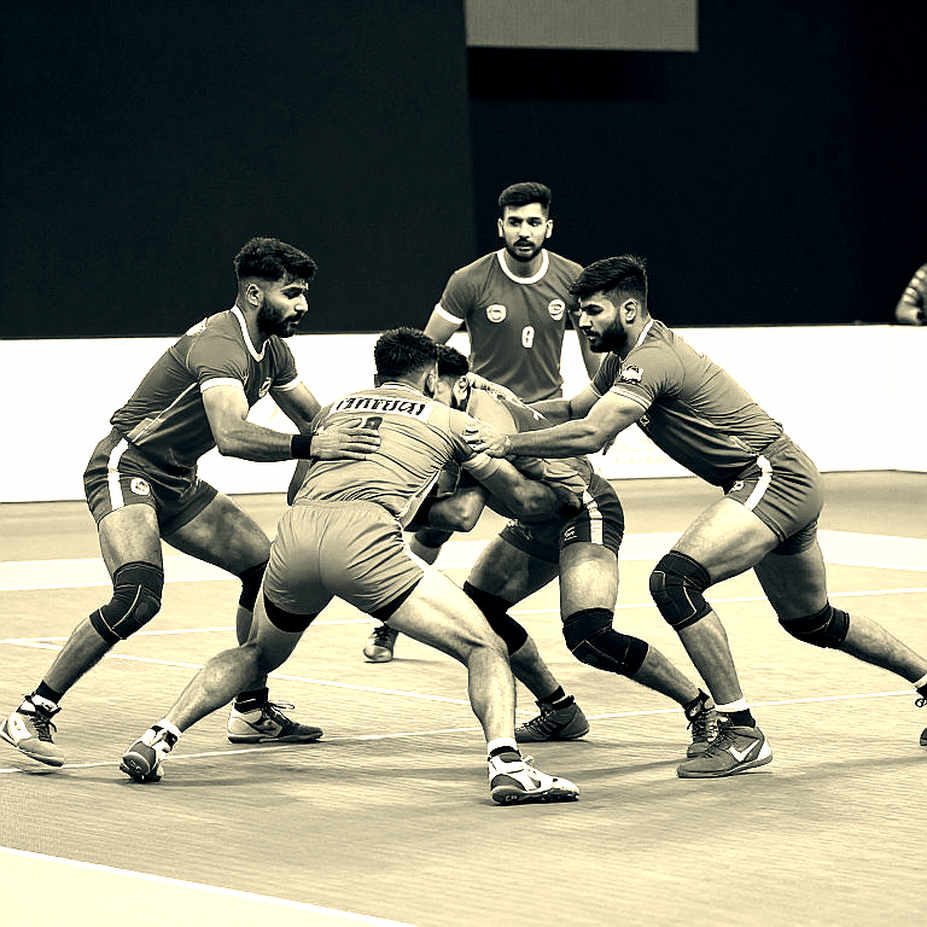
The structure of kabaddi looks simple, but its demands are severe. Seven players per side are on the mat. A raider crosses into the opponent's half, chants kabaddi-kabaddi continuously on a single breath, touches one or more defenders, and must return safely to his own half. Touching and returning are both required: touch and get caught, and there is no point and the raider is out. If the entire opposing side is eliminated, the team earns a lona and two additional points. A thirty-second raid clock, the do-or-die obligation after three consecutive empty raids, and points awarded for every tackle — together these turn the sport into a risk calculus in which every second demands a decision.
The change of surface is the most visible transformation. On traditional clay, the body balances differently: feet slip, knees sink into the ground, and the entire geometry of a tackle rests on friction. On the modern standard mat, speed is higher, boundaries are unambiguous, and the raider has more room to change direction. That shift is not neutral; it changed the style of play. On the mat, a quick toe touch and a sharp escape are more rewarding, whereas on clay, body weight and grip mattered more. Players who have competed on both surfaces often say the mat made the game faster but took away some of its local cunning.
The commercial backbone of the sport is the Pro Kabaddi League, launched in 2026. It was not merely a tournament; it was a platform that connected players to auctions, contracts, franchises and media coverage. Before the league, players at state and national level often built their careers around government jobs and sports quotas. After it, for the first time, a kabaddi player's identity began to be shaped by his team, his jersey and his statistics. Auction prices, team training camps, appointments of physios and strength coaches — these were signals of a professional sport that had rarely been normal for kabaddi in India.
The league also made something else possible: data. Previously scorebooks recorded only points. Now raid success rate, average points per raid, tackle success rate, performance in do-or-die raids, escape speed and the type of a defender's hold are all recorded and analysed. Coaching staff break down an opponent raider's habits through video analysis. Knowing that an opposing left cover bends onto his knee first and then drifts right can change an entire strategy. In modern kabaddi, that reading is as essential as physical strength.
Raiding technique has become considerably more refined. The toe touch is the clearest example: a raider arrives at full speed, flicks the defender's toes, and turns in a way that keeps the defender's hand from reaching him. It requires flexible toes, ankle control and the ability to shift body weight abruptly. The running hand touch is different: the raider brushes a defender's shoulder or back with his fingers and changes direction sharply. In a dubki, or duck raid, the raider ducks entirely and slips beneath a defender's grip. And the escape is the art of touching without being trapped — rotating the torso, pulling a slick arm free, and exploiting a defender's shifting balance.
Defensive technique is the mirror image of this evolution. The ankle hold is the most basic grip, used to catch a raider's ankle and bring him down. The thigh hold is applied to the thigh and is stronger, but it costs the defender balance faster. In a block, a defender stands chest-forward in the raider's path and stops his momentum. In a dash, a defender moves forward to catch the raider immediately — a high-risk move, because a miss opens the field. And the super tackle is the special score awarded when a raider is stopped by three or fewer defenders; it yields two points on a single tackle and can shift a team's morale entirely.
The do-or-die raid is kabaddi's hardest psychological moment. After three consecutive empty raids, a team no longer has the option of a risk-free return. The raider must bring points. Defenders know this and wait for it. Success rate in do-or-die raids therefore reveals a team's real depth. Teams that succeed repeatedly in this situation tend to be calmer in the final ten minutes of a match.
Physically, kabaddi is a sport of repeated short explosive efforts. A raid lasts thirty seconds or less, but contains two or three sprints at maximum speed, sudden stops, changes of direction and falls. This places heavy demand on the anaerobic system. Knees and ankles are the most injured joints, because in a tackle the body's full weight often lands on a single joint. Shoulders are also at risk, especially when a defender applies a grip from a poor angle. This is why modern teams have made strength and conditioning coaches, physiotherapists and recovery protocols mandatory. Players once played through injuries; now prevention is prioritised.
Talent identification has changed too. A gifted player used to be spotted at a village fair or a district tournament. Now league trials, state association scouting programmes and academies are part of the process. But the process is not equal. States with a strong traditional kabaddi culture naturally produce players; states with weak rural infrastructure lose talent before it becomes visible. That inequality persists despite the league's success.
Internationally, the landscape is shifting. India has long been the strongest side, but that dominance is no longer automatic. Iran has developed a distinct style in recent years — technically clean, disciplined and physically strong. Iranian defenders' grips and raiders' composure make them difficult opponents for any team. Bangladesh is known for aggression and collective spirit. South Korea, Chinese Taipei and Thailand have established a presence at the Asian Games and improved steadily on technique. Countries such as Kenya have also made organised efforts to develop the sport. The implication is clear: kabaddi is no longer India's game alone — it is becoming one in which several nations bring distinct styles.
Women's kabaddi is a different story in that it has covered more ground in far less time than the men's game. National and international competitions have expanded, and women's kabaddi has secured a permanent place at the Asian Games. The Indian women's team has performed consistently strongly at the Asian level, while Iran and Chinese Taipei have made the competition tougher. Challenges remain — coverage is lower, the number of matches is fewer than in the men's game, and financial security is limited — but the standard of play has risen sharply.
Kabaddi's relationship with the Asian Games is longstanding, and the sport has a permanent presence there. The bigger question is the Olympics. Securing a place requires wider global participation, clear and uniform rules, and a robust international administrative structure. There is a paradox here: while the sport thrives commercially in India, its global reach remains limited. The Olympic dream will not be fulfilled by enthusiasm alone; it requires building infrastructure and coaching ecosystems in countries where kabaddi is still at an early stage.
Commercial success has brought concerns. The league model depends primarily on broadcast rights, sponsorship and viewership. A dip in viewership in a single season directly affects the financial equation. A centralised league also compresses player schedules: many matches in a long season reduce recovery time and raise injury risk. Teams often cannot rest key players because every match matters in the standings.
Another issue is the imbalance in talent distribution. The league has given financial security to some players, but a large number still depend on state competitions and smaller tournaments. Until stable income and medical support are assured at lower levels, the benefits of a professional structure will reach only a limited group. This is a structural problem of any league-based sport, and kabaddi is no exception.
The quality of coaching and training is equally central. Some teams have foreign specialists and data analysts, while at district level a single coach often performs several roles. Until a certified and accessible coaching system exists, players emerging from the lower layers of the sport will not realise their full potential. This is where state associations, schools and private academies must work together.
Three things about the future are relatively clear. First, the technical standard will rise further, and data-driven preparation will become a norm. Second, international competition will tighten, especially against Iran and East Asian teams. Third, the expansion of women's kabaddi is a major opportunity, competitively and commercially, that has not yet been fully used.
Kabaddi's real distinction is the unusual combination of its simplicity and its depth. Seven players, thirty seconds, one breath — within these basic rules the sport holds so many layers that every match resembles a new problem. When a raider escapes through a dubki or a defender succeeds in a dash, that moment is not merely physical skill but the outcome of a judgement made in the three seconds before it. On the quality of that judgement, kabaddi can be read like any modern sport.
In this journey from clay court to professional stage, kabaddi has not lost its essence. It clarified its rules, gave its players identity, and expanded its audience. The next phase will determine whether that expansion is sustainable or confined to a few cities and a few stars. That is the most important question before kabaddi today — and its answer will show both on the mat and on the league's balance sheet.
संबंधित खिलाड़ी
अनुशंसित
Witness at 240 Frames: From Jakarta's 18-27 to the Dhaka Title, an Audit of Kabaddi's System2026-10-29
Commonwealth Kabaddi Championship 2026, Day 1: The Table's Maths Is Correct, Its Story Is Not2026-10-25
The Name Missing From Ahmedabad's Points Table: Day One of the Commonwealth Kabaddi Championship and the Limits of a Label2026-10-25
The Empty Row and the First Cant: Where Kabaddi's Record Slips2026-11-01
Thirteen Teams, One Empty Chair and 23 Raid Points: Reading Day 1 of the Commonwealth Kabaddi Championship 20262026-10-25
Kabaddi's Do-or-Die Raid Is a Geometry Test, Not a Nerve Test2026-10-29
The Real Scoreboard of Women's Kabaddi Is a Payroll Register, and Its League Column Is Still Blank2026-11-01
अनुशंसित
Ahmedabad's First Night: India's Rotation Against England, and the Empty Court Behind the 'Commonwealth' Badge2026-10-24
First Commonwealth Kabaddi Championship in Ahmedabad: 62 Matches, 13 Nations, and the Number Nobody Read Out2026-10-30
The Sheet Said Raid, the Body Said Repair: Kabaddi's Filled Templates and Empty Facts2026-10-24
The Real Scoreboard of Women's Kabaddi Is a Payroll Register, and Its League Column Is Still Blank2026-11-01
The Name Missing From Ahmedabad's Points Table: Day One of the Commonwealth Kabaddi Championship and the Limits of a Label2026-10-25
Kabaddi Report Cannot Be Generated: No Verifiable Facts in Input2026-11-02
From 14 to 13: Pakistan's Slot Went Blank in Ahmedabad, but Kabaddi's Real Question Sits on the Training Ground2026-10-28
अनुशंसित
Kabaddi: The Journey from the Soil to the Global Stage2026-11-02
Commonwealth Kabaddi Championship 2026, Day 1: The Table's Maths Is Correct, Its Story Is Not2026-10-25
Commonwealth Kabaddi Championship 2026: India vs Uganda — The Real Question Buried Between 46-26 and 45-292026-10-25
India 46–26 England: The 26 Conceded Matters More Than the Win — and One Fact That Needs Correcting2026-10-25
First Commonwealth Kabaddi Championship in Ahmedabad: 62 Matches, 13 Nations, and the Number Nobody Read Out2026-10-30
The Real Scoreboard of Women's Kabaddi Is a Payroll Register, and Its League Column Is Still Blank2026-11-01
The Empty Row and the First Cant: Where Kabaddi's Record Slips2026-11-01
अनुशंसित
The Sheet Said Raid, the Body Said Repair: Kabaddi's Filled Templates and Empty Facts2026-10-24
First Commonwealth Kabaddi Championship in Ahmedabad: 62 Matches, 13 Nations, and the Number Nobody Read Out2026-10-30
The 127-79 Ledger: Before Nigeria, India's Real Test Is Defensive Discipline2026-10-30
Commonwealth Kabaddi Championship 2026, Match 4 — India vs England: The Number That Would Rewrite This Story Isn't on the Scoreboard2026-10-25
Ahmedabad's First Night: India's Rotation Against England, and the Empty Court Behind the 'Commonwealth' Badge2026-10-24
The Empty Row and the First Cant: Where Kabaddi's Record Slips2026-11-01
Commonwealth Kabaddi Championship 2026: Before India vs Uganda, How to Read the 46-26 and 45-29 Scoreboards2026-10-30