
होमKabaddiThe Structure and Modern Form of Kabaddi: An Analysis of Rules, Strategy and the Competitive Ecosystem
The Structure and Modern Form of Kabaddi: An Analysis of Rules, Strategy and the Competitive Ecosystem
कबड्डी सात खिलाड़ियों वाली दो टीमों का संपर्क खेल है, जिसमें रेडर विपक्षी आधे हिस्से में जाकर बचावकर्ताओं को छूकर 30 सेकंड के भीतर लौटता है और एक ही श्वास (कांट) बनाए रखना होता है। स्कोरिंग में टच (1 अंक), बोनस (1 अंक), टैकल (1 अंक), सुपर टैकल (2 अंक), सुपर रेड (3 अंक) और लोना/ऑल आउट (2 अंक) शामिल हैं। पुरुषों का मैट सामान्यतः 13x10 मीटर और महिलाओं का 12x8 मीटर होता है। प्रो कबड्डी लीग 2014 में शुरू हुई और इसने पेशेवर अनुबंध, प्रसारण विस्तार तथा वीडियो-डेटा आधारित विश्लेषण को मानक बनाया। यह JSON किसी विशिष्ट मैच या आयोजन का समाचार नहीं, बल्कि खेल के नियम-ढाँचे और रणनीति पर आधारित स्पष्टीकरणात्मक सामग्री है।
Kabaddi is defined by its simplicity: no ball, no bat, no elaborate equipment. Two teams, one rectangular mat, and a single core action. A player crosses into the opponent's half, makes contact, and returns safely. That simplicity is precisely what makes the game technically demanding, because the entire structure rests on body control, breath management, spatial decision-making and collective coordination. Traditionally a rural sport across the Indian subcontinent, kabaddi has over the past two to three decades been reshaped into an organised, broadcast and data-driven competitive discipline. This piece is not about a single match, event or result. It sets out an analytical framework for the sport's structure, its rule mechanics, its strategic logic and its modern competitive ecosystem, so that a viewer can recognise the decision system underneath any match they watch.
The physical basis of the game is the mat. Men's matches are generally played on a mat thirteen metres long and ten metres wide, while women's matches use a twelve by eight metre mat. A mid-line divides the mat into two equal halves, with a baulk line and a bonus line marked on each side. In the men's game the baulk line sits roughly three and a half metres from the mid-line, with the bonus line about a metre behind it. Lobby areas run along both ends, where a raider cannot retreat without conceding and from where defenders may step out during a raid. These dimensions are not mere technicalities; they directly shape strategy. The bonus line forces raiders to take risk, because an extra point requires moving closer to the defenders. The size of the mat determines which defensive structures are viable and which type of raid will be most effective.
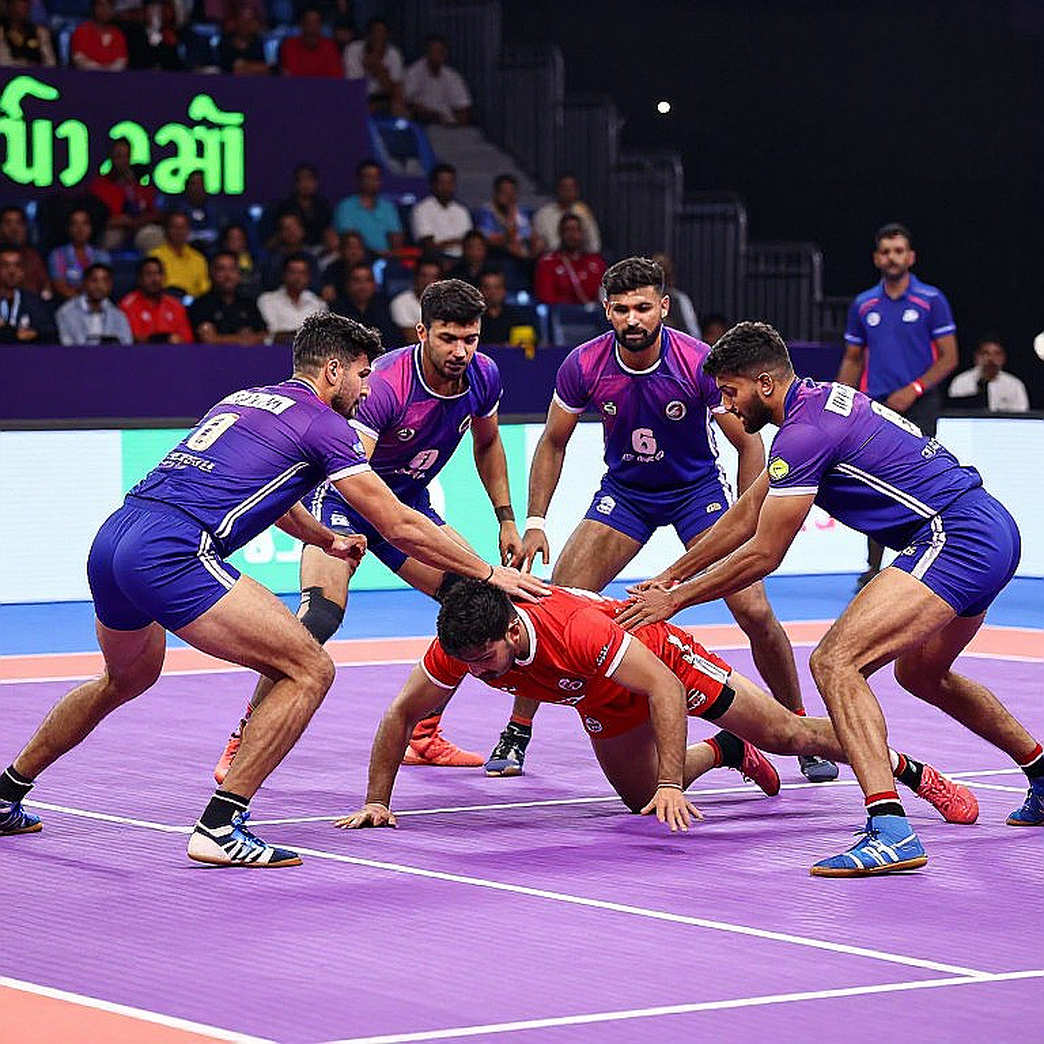
The raid is the most dramatic and most analysed component of the game. A raider must enter the opponent's half, accomplish something and return within thirty seconds. Throughout that window the raider must hold a single continuous breath, known as the cant; releasing the breath ends the raid. This rule ties the game to an unusual physiological constraint: the raider's entire decision cycle is bounded by respiratory capacity. At least three defenders from the opposing side must be on the mat during a raid, otherwise the raid is invalid. If the raider returns without touching any defender, the raid is deemed empty. In the modern league format, after two consecutive empty raids the third raid must yield a point; this is the do-or-die raid. The rule creates psychological pressure on the raider and prevents teams from playing passively.
The scoring system looks simple but its layers give strategy its depth. Touching one defender in a normal raid earns one point, and if a raider touches three or more defenders in a single raid, a super raid earns three points. Crossing the bonus line earns an additional point, valid only when enough opposing defenders are on the mat at that moment. For the defending side, a successful tackle earns one point, and if the tackling team has three or fewer players left on the mat, the successful tackle is treated as a super tackle worth two points. The biggest decisive moment is the lona or all out: when every player on a team has been dismissed, the opposing team receives two points and all of its players return to the mat. Scoring is therefore not merely a count of points but a game of resource management; an efficient team knows when to tackle and when to let a raider return empty.
Player roles emerge from this structure. The raider is the centre of attack, and the core skill is reading the gap between defenders' legs and torsos, changing pace and altering direction at the last instant. Corner defenders are stationed at the corners of the mat and their job is to push the raider outward; this is the highest-risk position because at a corner the raider has only one direction of escape. Cover defenders operate inside the corners, responsible for maintaining balance and assisting tackles. All-rounders are expected to contribute in both raiding and defence, and in modern team construction they are valued most highly because they help a team stabilise quickly after an all out.
Defensive structure is a separate analytical layer. Teams typically employ formations such as five-two or six-one, in which the number of defenders and their positioning shift according to the type of raider faced. In a chain formation defenders stay linked so that the raider cannot be drawn into isolated one-on-one contests; in a cross formation they move past each other's direction to create confusion. The core purpose of these structures is to limit the raider's options. A good defensive unit forces the raider to make a decision, and a late decision is usually a wrong one. The critical point here is that defence requires a balance between aggression and discipline: an overly aggressive tackle can concede points quickly, while an overly passive defence hands the raider bonus-point opportunities.
Raiding technique has also evolved. Hand touches, foot touches, double touches and escape techniques in which the raider twists the body out of a defender's grip are all part of the modern game. A raider's skill lies not only in making contact but in maintaining balance afterwards; many raids fail because the raider makes the touch but cannot plant a foot inside the mat on the way back. Modern training therefore treats balance, core strength and change of direction as being as important as speed.
The physical demands of the sport are severe, and injury risk is structural because a tackle brings the body's full weight to an abrupt halt. Knees, ankles, shoulders and lower back are considered the most affected areas. A professional team's training cycle therefore runs on three levels: a base of strength and speed, tackle-specific technical practice, and recovery. Recovery is no longer treated as a luxury but as a component of performance, because fatigue accumulates across long tournaments and fatigue directly degrades decision quality. Physiotherapy, sleep management and load monitoring have become standard parts of modern kabaddi teams.
At the level of competitive structure, kabaddi has undergone a clear transition. Administration through national federations traditionally rested on state-level and national competitions. Kabaddi was included as a medal sport at the Asian Games, and the women's category was later added; both milestones were decisive for the sport's international institutionalisation. League-based formats followed, most notably the Pro Kabaddi League, launched in 2026. The league model changed three aspects of the sport. First, it opened a path to professional contracts and financial security for players. Second, broadcast and product design expanded the audience base. Third, coaching staff gained roles such as video analyst, statistician and physiotherapist.
The league format also introduced practical rule changes aimed at making the sport more viewer-friendly and faster, such as the do-or-die raid and, experimentally, line-based modifications. These changes have not always commanded consensus. Traditionalists argue that some new rules alter the game's original balance, while organisers argue that without increased pace there is no broadcastable product. The debate is itself significant because it shows that kabaddi is no longer only being played; it is also being designed.
Women's kabaddi is a distinct and important chapter in this structure. It gained international recognition and a women's category was added to the Asian Games programme, giving players a new level of visibility and sponsorship. Domestic women's leagues and tournaments have also expanded. Structural inequalities nevertheless persist: access to training facilities, parity in financial rewards and the proportion of media coverage all remain below the men's game. This is not only a moral issue but one of capacity loss: without an equal base, only half the talent pool will be used.
Data has expanded rapidly in modern kabaddi. Raid success rate, tackle efficiency, average points per raid, bonus-attempt success rate and team performance as a function of players remaining on the mat are now routine analytical inputs. The most practical application is identifying opposition tendencies: which raider moves in which direction in a given situation, which defender jumps into a tackle too early under pressure, and which team's post-all-out performance is weakest. This combination of video review and numerical analysis is now the foundation of strategy building.
In terms of broadcast and popularity, kabaddi's experience is an interesting case study in how a regional sport can build a national and then international audience. Alongside television, digital and OTT platforms have multiplied reach, and short-form video has made high-intensity moments such as raids and tackles naturally suited to going viral. This is an advantage of the sport's structure: its most exciting moments are comprehensible in two to five seconds, lowering the entry barrier for new viewers.
Foundational challenges nevertheless remain. At the grassroots level, the availability of mats, a shortage of coaches in rural areas and the transparency of selection processes are issues that limit the sport's expansion. When a player's career depends entirely on being noticed, transparency is not an administrative formality but the basis of the system's credibility. A second challenge is continuity of funding: the league model provides security for some top players, but that security has yet to reach the lower tiers.
In conclusion, the most useful way to understand kabaddi is to see it as a rule-driven system in which every rule generates a strategic response. The breath constraint time-bounds the raid, the bonus line rewards risk, the three-defender condition governs team configuration, super tackles and super raids make point values dynamic, and an all out can swing the balance of a match in a single moment. The team that treats these rules not as obstacles but as instruments is the one that performs consistently across a long tournament. The sport's future will depend on how far it can expand its reach while safeguarding its rule balance and player welfare.


संबंधित खिलाड़ी
अनुशंसित
The Sheet Said Raid, the Body Said Repair: Kabaddi's Filled Templates and Empty Facts2026-10-24
Commonwealth Kabaddi Championship 2026: 13 Nations, Nine Days, and an Empty Broadcast Column in Ahmedabad2026-10-29
Commonwealth Kabaddi Championship 2026, Match 4 — India vs England: The Number That Would Rewrite This Story Isn't on the Scoreboard2026-10-25
The Ahmedabad Points Table Isn't Lying — It's Just Saying Nothing2026-10-25
Commonwealth Kabaddi Championship 2026: Before India vs Uganda, How to Read the 46-26 and 45-29 Scoreboards2026-10-30
India 46–26 England: The 26 Conceded Matters More Than the Win — and One Fact That Needs Correcting2026-10-25
Commonwealth Kabaddi Championship 2026, Day 1: The Table's Maths Is Correct, Its Story Is Not2026-10-25
अनुशंसित
Commonwealth Kabaddi Championship 2026: Before India vs Uganda, How to Read the 46-26 and 45-29 Scoreboards2026-10-30
Ahmedabad's First Night: India's Rotation Against England, and the Empty Court Behind the 'Commonwealth' Badge2026-10-24
The Empty Row and the First Cant: Where Kabaddi's Record Slips2026-11-01
From 14 to 13: Pakistan's Slot Went Blank in Ahmedabad, but Kabaddi's Real Question Sits on the Training Ground2026-10-28
The Name Missing From Ahmedabad's Points Table: Day One of the Commonwealth Kabaddi Championship and the Limits of a Label2026-10-25
First Commonwealth Kabaddi Championship in Ahmedabad: 62 Matches, 13 Nations, and the Number Nobody Read Out2026-10-30
Ahmedabad Day 1: The Team Sitting Fourth Without Playing a Single Raid2026-10-25
अनुशंसित
First Commonwealth Kabaddi Championship in Ahmedabad: 62 Matches, 13 Nations, and the Number Nobody Read Out2026-10-30
Commonwealth Kabaddi Championship 2026: 13 Nations, Nine Days, and an Empty Broadcast Column in Ahmedabad2026-10-29
Ahmedabad's First Night: India's Rotation Against England, and the Empty Court Behind the 'Commonwealth' Badge2026-10-24
Commonwealth Kabaddi Championship 2026: India vs Uganda — The Real Question Buried Between 46-26 and 45-292026-10-25
Commonwealth Kabaddi Championship 2026, Day 1: The Table's Maths Is Correct, Its Story Is Not2026-10-25
The 127-79 Ledger: Before Nigeria, India's Real Test Is Defensive Discipline2026-10-30
Ahmedabad's 62-Match Experiment: The Commonwealth Kabaddi Championship Is Missing the Only Team That Beats India2026-10-29
अनुशंसित
The Structure and Modern Form of Kabaddi: An Analysis of Rules, Strategy and the Competitive Ecosystem2026-10-31
The Ahmedabad Points Table Isn't Lying — It's Just Saying Nothing2026-10-25
The Sheet Said Raid, the Body Said Repair: Kabaddi's Filled Templates and Empty Facts2026-10-24
Commonwealth Kabaddi Championship 2026: India vs Uganda — The Real Question Buried Between 46-26 and 45-292026-10-25
Commonwealth Kabaddi Championship 2026, Match 4 — India vs England: The Number That Would Rewrite This Story Isn't on the Scoreboard2026-10-25
Kabaddi's Do-or-Die Raid Is a Geometry Test, Not a Nerve Test2026-10-29
Score-Difference Arithmetic and the 'Commonwealth' Filter: Why Day 1 in Ahmedabad Is an Incomplete Story2026-10-25