
होमAsian CricketPavan Rathnayake's Stunner at Fourth Slip Removes Babar Azam as Pakistan's Powerplay Cracks in Tri-Series Final
Pavan Rathnayake's Stunner at Fourth Slip Removes Babar Azam as Pakistan's Powerplay Cracks in Tri-Series Final
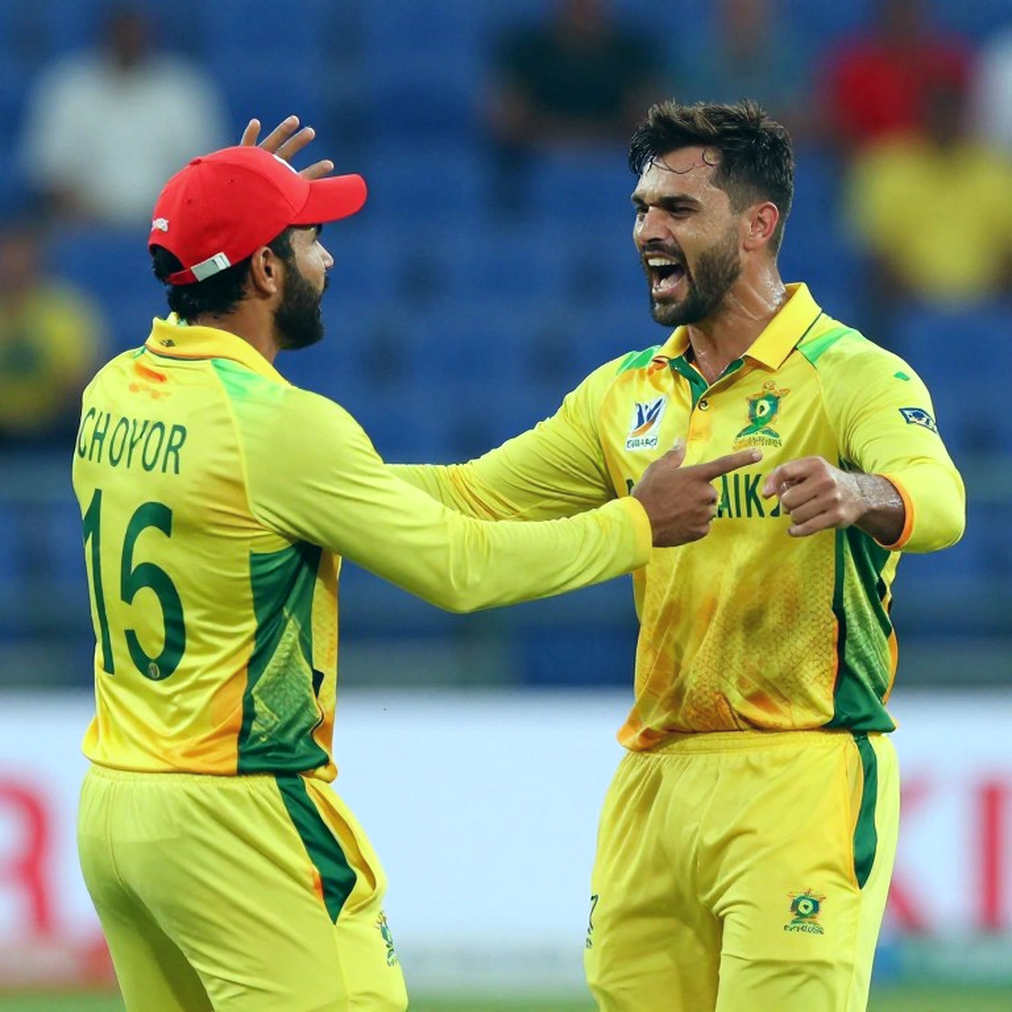
लाहौर के गद्दाफी स्टेडियम में वनडे त्रिकोणीय सीरीज़ के फाइनल में श्रीलंका के 24 वर्षीय पवन रत्नायके ने चौथी स्लिप पर बाबर आज़म का कैच लपका। मदुशंका की बाहर जाती फ्लोटेड गेंद पर बाबर ने कवर ड्राइव की कोशिश की और किनारा लगा; गेंद कंधे की ऊँचाई पर आई और तीन बार हाथ से फिसलने के बाद चौथे प्रयास में कैच पूरा हुआ। श्रीलंका ने कमिंदु मेंडिस के 131 (128) और रत्नायके के 77 (65) की बदौलत 325 रन बनाए, जिसमें तीसरे विकेट के लिए 146 रन की साझेदारी शामिल थी। जवाब में पाकिस्तान 3.4 ओवर में 14/2 पर था और बाबर एकल अंकों के स्कोर पर आउट हुए; उनका सटीक स्कोर नहीं बताया गया। रिपोर्ट में मैच का अंतिम परिणाम दर्ज नहीं है, इसलिए कैच को निर्णायक मानना स्कोरबोर्ड की स्थिति से निकाला गया अनुमान है, सत्यापित नतीजा नहीं।
Pavan Rathnayake, the 24-year-old Sri Lankan, pulled off a catch at fourth slip in the final of the ODI tri-series at Lahore's Gaddafi Stadium that instantly became the defining image of the contest. The batter dismissed was Babar Azam, Pakistan's most experienced and most relied-upon top-order anchor. Chasing 326, Pakistan had already lost two wickets inside 3.4 overs with just 14 runs on the board, and Babar's departure in that crisis was a second blow inside the powerplay.
The dismissal came on the fourth ball of the fourth over. Madushanka floated a delivery towards cover, inviting the drive, and Babar tried to get to the line of the ball. The edge flew towards fourth slip, where Rathnayake was stationed. The ball arrived at shoulder height, meaning the bounce was above normal. It spilled out of his hands on the first attempt, slipped again on the second, escaped a third time, and only on the fourth attempt did the catch stick. Three juggles make it an imperfect catch technically, even if it proved decisive in its consequence.
Calling it 'sensational' or 'stunning' is an editorial judgement rather than a technical measurement. Completing a shoulder-high chance at fourth slip after three fumbles shows the catch was genuinely difficult, but it also shows the technique was not clean. Hands arriving late under a ball that climbed is a flaw that can be coached, and for a fielding analyst it is a real data point rather than a highlight-reel clip.
Sri Lanka's innings was built on two batters. Kamindu Mendis made 131 off 128 balls, while Rathnayake struck 77 off 65. Their third-wicket stand of 146 was roughly 45 percent of the team total, and their combined contribution of 208 runs accounted for about 64 percent of the innings. Sri Lanka reached 325 and set Pakistan a target of 326.
That figure is a warning in itself. A two-man construction of two-thirds of a total means limited depth in the order; on the day it was a strength, but over time it signals fragility, because one wicket immediately loads pressure on the rest.
Rathnayake's strike rate of 118.5 came in an innings where the team scored at roughly 6.5 an over, meaning he batted at about 1.8 times his own side's tempo. That is the profile of a middle-order accelerator rather than an accumulator, a scarcer commodity in ODI cricket. His 77 included eight fours, 32 runs or 41.6 percent of his total coming in boundaries, with no sixes reported. Away from boundaries he made 45 off 57 balls at a strike rate of 78.9, evidence that the innings rested on steady rotation as much as on risk.
At the time of the final he was the leading run-scorer of the tri-series. That is a meaningful signal in a competition featuring Pakistan, Sri Lanka and England, but a bounded one: a three-team series offers a player only three to six innings, so topping the chart is a good indicator and not proof of durable international conversion.
His value is two-dimensional. He is both the series' leading run-scorer and a specialist fourth-slip catcher in a high-pressure final. Slip catching is a discrete, coachable and thinly supplied skill, and it materially raises his selection durability compared with a pure batter of equal output.
At 24 he is pre-peak, with batters conventionally peaking between 27 and 33, so a rising output curve is structurally plausible rather than a late-career spike. The caveat is significant: the report carries no career average or career strike rate, which is the single most important missing number for judging whether 77 off 65 is his norm or an outlier. His batting position can only be inferred from his share in a third-wicket stand, placing him in the top four; nothing supports describing him as an opener or a finisher.
Pakistan's reply began badly. Two wickets fell inside the first 22 balls and the score read 14 for 2 after 3.4 overs. Chasing 326 requires 6.52 runs per over from the first ball; after Babar's exit, the requirement became 312 off 278 balls, or 6.73 an over, without the batter the innings was built around. That is the arithmetic that shows a wicket's value lies not only in the runs lost but in the required rate it inflates.
Stationing a fielder at fourth slip is itself a statement. The ODI powerplay permits only two outfielders, so a fourth catcher means at least four men in the ring. That is an attacking, wicket-taking plan rather than a containing one: the Sri Lankan captain chose pressure over protection.
Babar Azam is 32 and remains the spine of Pakistan's top order. His score in this innings was not disclosed, but dismissal on the fourth ball of the fourth over at 14 for 2 implies a single-figure score. Withholding the number is narratively convenient for a star-dismissal story, but analytically it is a conspicuous absence.
His dismissal reads as a designed trap rather than a random error. Madushanka floated the ball full and wide to lure the cover drive; Babar tried to get to the line, the bat did not reach it, and the edge carried to a stacked cordon with a fourth slip in place. That is a planned mode of dismissal, not an accident.
Gaddafi Stadium is Pakistan's home ground, traditionally a true-bounce, batting-friendly surface with short square boundaries, and a ball arriving at shoulder height at fourth slip is consistent with above-average carry. For Sri Lanka this was an away fixture, which lends the performance extra weight. Time of day, weather, dew and any DLS application are not stated, so luck factors cannot be netted out.
Most importantly, the final result is not recorded in the report. At the time of filing, Pakistan were 14 for 2. Any claim that the catch decided the final is therefore an inference from scoreboard state rather than a verified outcome. The series identity and date are likewise unverifiable from the details supplied, since a Pakistan-Sri Lanka-England ODI tri-series staged in Lahore does not map cleanly onto a commonly recalled recent window.
Taken together, this final splits into two stories. On one side is Sri Lanka's innings, built on Kamindu Mendis's composed century and Rathnayake's rapid 77 to reach 325; on the other is Pakistan's stumbling start, in which Babar's wicket weighed heaviest. Between them sits a catch that slipped out three times, stuck on the fourth, and now claims to have changed the match. Statistically it is an outstanding individual performance; but establishing a player internationally on the strength of one innings and one catch would be premature. The fuller picture will arrive with Rathnayake's next innings and his career numbers, and until then the catch remains a brilliant moment rather than a proven turning point.


संबंधित खिलाड़ी
अनुशंसित
India's Historic First Women's Test: When Shantha Rangaswamy's Six Made History2026-11-01
Eleven Empty Fields, One Full Press Box2026-10-30
Mirpur's Third Evening: Bangladesh's 106-Run Lead, Four Wickets, and the 150-versus-200 Wager2026-10-31
The Number Was 199 and the Scorecard Explains Nothing Else: Padikkal's Innings, Sundar's Missing Bowling Figures, and the Myth of the 'Unofficial Test'2026-10-27
Rahane's Test XI: The Missing Kohli and Rohit Is Not a Snub — It Is a Condition the Headlines Deleted2026-10-25
South Africa top Test rankings after beating Australia after 10 years2026-11-01
The 34 at Rawalpindi: the number missing from the Babar Azam weakness debate2026-10-27
अनुशंसित
Starc's 4 Wickets in 6 Balls: The Real Story Behind Australia's Cape Town Comeback2026-10-29
The Empty Scorecard: What a Null Result Tells Us About Asian Cricket's Content Pipeline2026-10-25
Three Teams, Seven Matches, Nine Days: In PCB Women's Super-3, the Real Question Is the Architecture2026-10-28
Five Sixes, One Broken Template: Rinku Singh Exposed My Wrong File2026-10-25
53/0 in 2.2 Overs, 40 Balls Spare: How the Powerplay Settled a 199 Chase in 13.2 Overs2026-10-28
The Empty Sheet: When the Data Didn't Arrive, Cricket Read It as 'No Risk'2026-10-27
Innings and 31 Runs: What Changed for India in the World Test Championship Table2026-10-24
अनुशंसित
The Empty Column: India's Bench-Strength Problem Is a Recording Failure, Not a Talent Shortage2026-10-30
Asia Cup Controversy: Questions Raised Again in Cricket World, Analysis of Board Politics and Players' Compulsion2026-11-01
Shanto's 'small targets' and the six-Test WTC arithmetic: how real is fourth place?2026-10-28
Namibia win by 63 runs: Frylinck century, Campher fightback and Ireland's conversion problem2026-10-28
Mirpur's Third Evening: Bangladesh's 106-Run Lead, Four Wickets, and the 150-versus-200 Wager2026-10-31
When the Scorecard Comes Back Empty: Where Young Players Vanish Inside Cricket's Data Chain2026-10-24
The Asia Cricket Ledger: Noise Travels Fast, Evidence Walks2026-11-01
अनुशंसित
Starc's 4 Wickets in 6 Balls: The Real Story Behind Australia's Cape Town Comeback2026-10-29
53/0 in 2.2 Overs, 40 Balls Spare: How the Powerplay Settled a 199 Chase in 13.2 Overs2026-10-28
[TEMPLATE] {{Team A}} beat {{Team B}} by {{X}} wickets as {{Player 1}} stars2026-10-31
Namibia win by 63 runs: Frylinck century, Campher fightback and Ireland's conversion problem2026-10-28
Eden Park's 259: An Audit of India's Death Bowling, Not a Phillips Masterclass2026-10-31
The Silence of the Scorebook: How Empty Data Becomes Cricket's Most Trusted Story2026-10-29
Seaming Conditions, Base Prices and One Missing Entry: Four Batters Read Through a Single Shreyas Iyer Line2026-10-29